Written for Dance Magazine, May 13, 2026
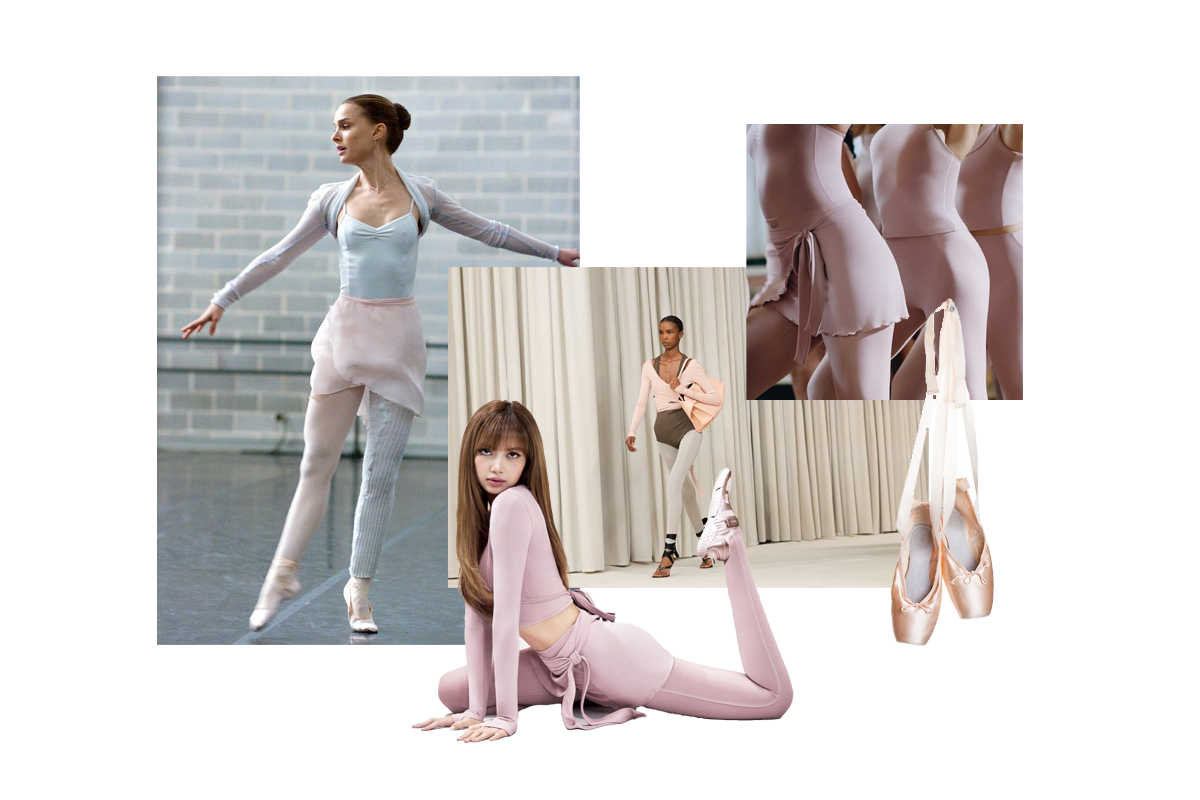
The balleternet had a collective aneurysm when Kim Kardashian’s clothing brand Skims collaborated with Nike on a balletcore collection, tapping pop star Lisa to model the line in a promo choreographed by Sergio Reis and Malou Linders. Dancers ran to Reddit, Instagram, and TikTok to make videos, commiserate, and express indignation.
“They are appropriating ballet—our culture is not their costume!”11 “More polyester clothing, how environmentally unfriendly.”2 “What’s Lisa from BLACKPINK doing, hip hop at a barre?!”3
“KIM, THERE’S PEOPLE THAT ARE DYING.” – KOURTNEY KARDASHIAN
I get it. Balletcore feels like capitalism co-opting art—using ballet to sell product. Accordingly, we assume balletcore wearers want to look like ballerinas but have no real interest in ballet.
Still, the moral outrage seems disproportionate. “Y’all need to touch grass,” I said at the time, frustrated that people weren’t as vocal about serious inequities that plague the ballet industry—like racism, sexism, and exploitation.
We take offense at people wearing inaccurate aesthetic ideals of ballet. But what attracted many of us to ballet was an inaccurate ideal—the magic of our first ballet, the sartorial appeal of tutus and ballet flats, or watching Natalie Portman go stir-crazy in Black Swan when homegirl should have gone for therapy instead.
The commercialism of ballet brings in new dancers and audiences. It’s essential for ballet’s survival. We know this. We know art dies if it’s not seen, that ballets are expensive. We want dancers to make a living wage.
So why do we dislike balletcore? Because ballet is not just movement to us. It is communion and self.
“NEVER GO AGAINST THE FAMILY.” – KRIS JENNER
Ballet is built on centuries of practitioners who came before us, an evolution of technical movement, of codes and unwritten values. A corps de ballet is testament to this—individuals who, through violence of effort, achieve an otherworldly whole. And we who dance have toiled to earn our place in ballet. In class, we understand there is a respectful way to behave, move—and dress. Onstage, dancers give of themselves to create beauty and evoke awe, and audiences give back in applause.
The collective effort enables us to commune with the art and each other. To instinctively understand what makes a good tendu, to playfully debate whether tights should be worn over or under leotards.4 Ballet gives us a sense of belonging— like the immigrant enclaves of Little Italy and Chinatown, or that three-person group chat with the weird name we have. It’s our tribe.
And in this belonging we place our identity.
“THERE’S A LOT OF BAGGAGE THAT COMES WITH US, BUT IT’S LIKE LOUIS VUITTON BAGGAGE; YOU ALWAYS WANT IT” – KIM KARDASHIAN
Because ballet is collective yet individual. We work at the barre on the same exercises, but within the abilities of our own bodies, in whatever way we feel enables us to dance. Our relationship with ballet is hugely personal because ballet is whatever we want it to be.
Ballet gives us highs and hopes—the thrill of live performance, of landing our first triple. And our lows aren’t about ballet technique but, rather, the culture surrounding ballet. Movement isn’t sentient, so it only demands as much as we demand from ourselves. Each time we dance, we put ourselves into it—our insecurities, flaws, and accomplishments, all reflected at us in studio mirrors.
Maybe that’s why we don’t like balletcore.
“IT’S JUST NEVER BEEN MY THING, NOT INTO IT — SO, NOT APPROVED BY ME” – KIM KARDASHIAN
We fear the dilution of something that is part of our identity. We worry that balletcore will turn what we love into something unrecognizable. We want ballet to be successful because we love it, and we feel threatened when we cannot control the directions it veers. We want ballet to be inclusive yet exclusive.
But dance is breathing, living. It evolves with everyone who has ever stepped into a studio. And everyone who feels deeply connected to ballet works to preserve its essence, while carrying it into the present.
I think of Phil Chan and Georgina Pazcoguin’s tireless work de-Orientalizing ballet at Final Bow for Yellowface. Or islands, an Emma Portner creation for the Norwegian National Ballet that challenges the strictures of ballet and allows female queerness to simply exist onstage. Even myself, a decidedly average adult dancer—in every pirouette I fall out of, every movement I try to connect to music, every correction I try to internalize, I carry on the language of ballet.
Whether we are students, hobbyists, professionals, educators, all we can do is hold our respect for ballet as we constantly examine what kind of dancers and community we want to be. Because despite the distaste for balletcore, most dancers wouldn’t hesitate to help a beginner figure out a jeté, or explain to a confused seatmate why two people dressed as cats are dancing in Act III of Sleeping Beauty.
Balletcore can be the gateway to someone’s deeper interest in ballet, and we should welcome people who wish to engage meaningfully with it. Maybe curiosity will lead them to a class, or their first Swan Lake. For everyone else whose only interest in ballet is wearing tulle skirts and shoes with criss-cross ribbons—let them have their fun. Even if they never want to understand the impossibility of perfecting a plié, they keep ballet in the general consciousness.
Or, as a Kardashian-adjacent man said in an opinion that some5 may consider entitled, they help “keep this [dying art] alive.”
- And yet we still buy tickets to La Bayadère. ↩︎
- And yet we still buy polyester leotards. ↩︎
- And yet we don’t research other dance genres enough to realize it’s not hip hop—it’s more of a ballet-inspired commercial dance fusion ↩︎
- Over, it makes bathroom breaks easier ok? I can’t explain it it just does ↩︎
- By “some,” I mean me ↩︎
Leave a Reply